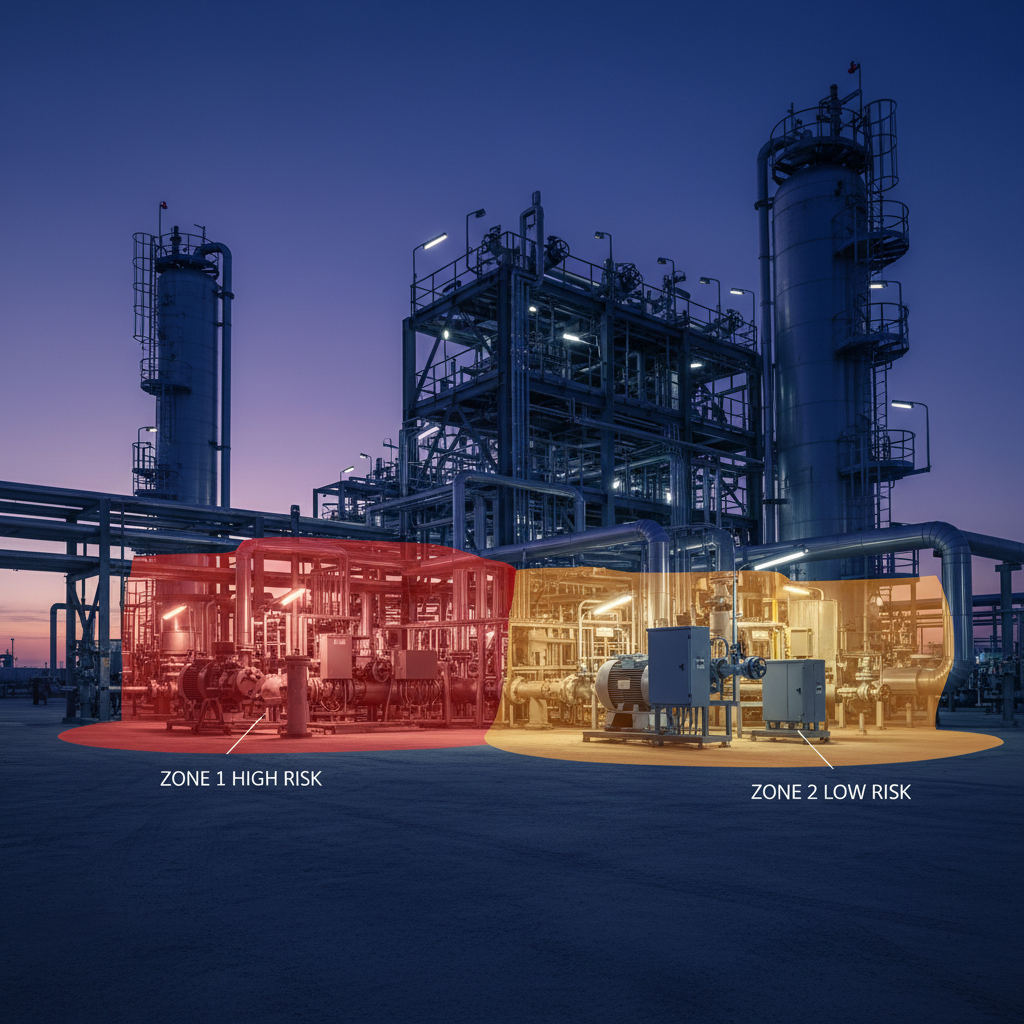
Classification of areas where combustible dusts and flammable gases may be present
Hazardous Area Classification (HAC) is the systematic identification and classification of areas where explosive atmospheres may occur due to the presence of combustible dusts (Zone 20, 21, 22) or flammable gases and vapors (Zone 0, 1, 2). This classification determines the type of electrical and mechanical equipment that can be safely used in these areas, preventing ignition sources that could trigger explosions.
Our HAC services follow international standards including IEC 60079, NFPA 70 (NEC), and local regulations to ensure proper classification and equipment selection for both dust and gas hazards. We provide detailed area classification drawings and documentation that help organizations comply with safety requirements while optimizing equipment costs.
Proper hazardous area classification is essential for workplace safety and regulatory compliance, protecting both personnel and facilities from the devastating consequences of dust and gas explosions.
Areas where combustible dust is present continuously or for long periods. Equipment must be suitable for continuous operation in explosive atmosphere.
Areas where combustible dust is likely to occur in normal operation. Equipment must be protected against dust clouds during normal operation.
Areas where combustible dust is not likely to occur in normal operation but may occur infrequently. Equipment must be protected against dust clouds in abnormal conditions.
Areas where flammable gas or vapor is present continuously or for long periods. Equipment must be suitable for continuous operation in explosive atmosphere.
Areas where flammable gas or vapor is likely to occur in normal operation. Equipment must be protected against gas clouds during normal operation.
Areas where flammable gas or vapor is not likely to occur in normal operation but may occur infrequently. Equipment must be protected against gas clouds in abnormal conditions.
Systematic classification of all facility areas based on dust presence, dispersion patterns, and operational conditions.
Detailed area classification drawings showing zone boundaries, equipment locations, and classification rationale.
Guidance on selecting appropriate explosion-proof or dust-tight equipment for each classified zone.
Comprehensive documentation including classification reports, equipment lists, and compliance verification.
Review of existing equipment and installations to ensure compliance with classification requirements.
Periodic review and reclassification when processes, equipment, or operations change.
Comprehensive site visit to identify all areas where combustible dusts are present, processed, or may accumulate.
Analysis of dust dispersion patterns, ventilation systems, and process conditions to determine dust cloud formation potential.
Systematic determination of Zone 20, 21, 22 (dust) and Zone 0, 1, 2 (gas) areas based on hazard presence frequency and duration.
Definition of zone boundaries considering dust properties, ventilation effectiveness, and process characteristics.
Creation of detailed area classification drawings showing all zones, boundaries, and equipment classifications.
Comprehensive report with classification rationale, equipment requirements, and recommendations for compliance.
Food processing, pharmaceuticals, chemicals, and general manufacturing facilities.
Petrochemical, specialty chemicals, and bulk chemical processing plants.
Grain handling, feed processing, and agricultural product manufacturing.
Metal powder production, machining, and metalworking operations.
Ensure proper equipment selection and compliance. Contact our HAC experts today for a comprehensive classification assessment.
Inquire About This Service